01 / 10

A till for the informal economy.

Mozambique's shops, bars and mercearias run on memory and paper. kaixa gives them a till, the stock behind it and the day's result - free, forever, for everyone.

Ten screens: the problem, the product, the moment it exists for, how a merchant gets in, why it costs nothing, what protects it, how it reaches people, what comes next, and exactly where it stands today.

Internal - prepared for Tiago and Hugo Morgado, 3 August 2026.
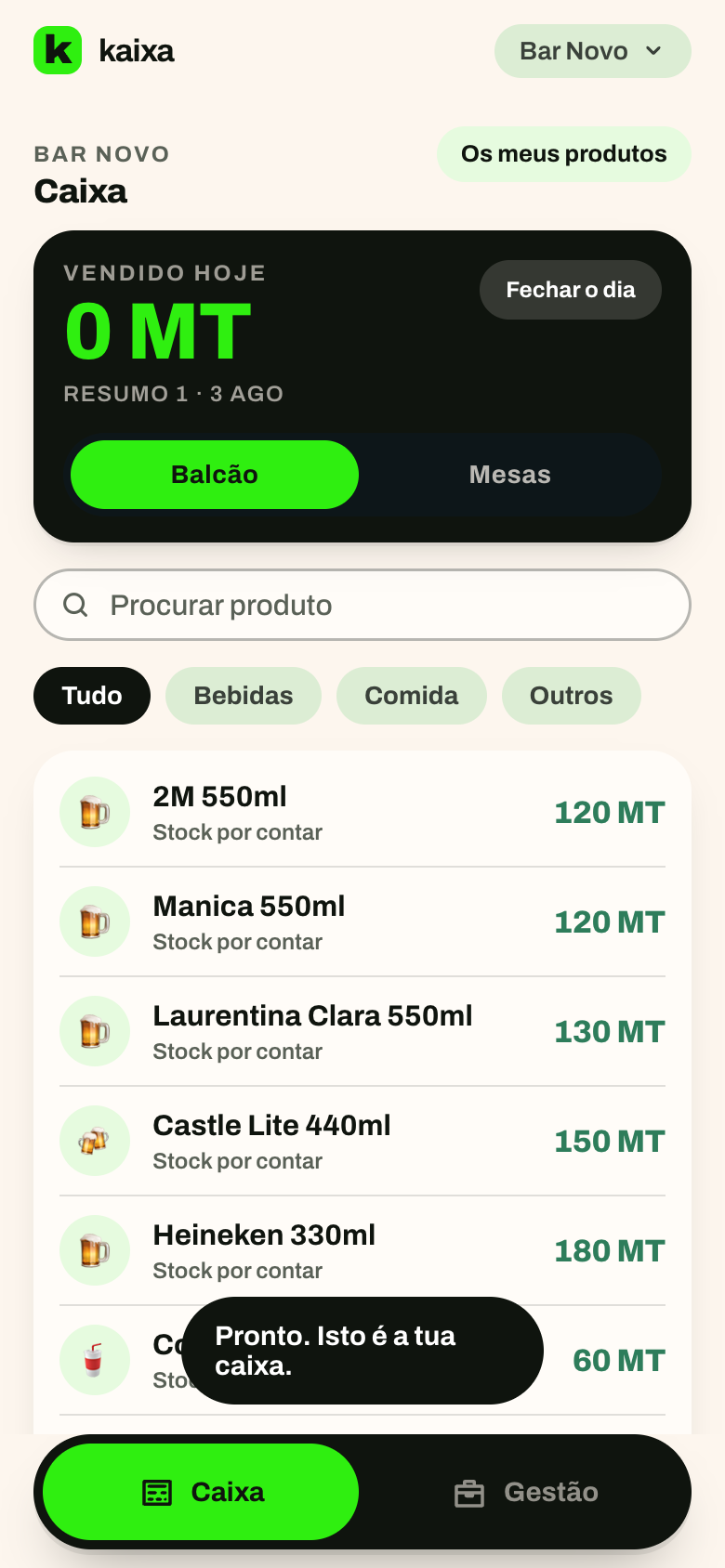
A merchant's own till, minutes after signing up
02 / 10
The problem

A quarter of a million businesses that keep no books.

250,000+
Handling customers - bars, bottle stores, mercearias, quiosques. Verified against the customer mirror, 20 July 2026.
10-15,000
transactions a day between Handling and those customers.
85%
of Mozambique's workforce is unbanked. No record means no credit and no visibility - for them or for anyone selling to them.
03 / 10
What it is

A till, and the brain behind the till.

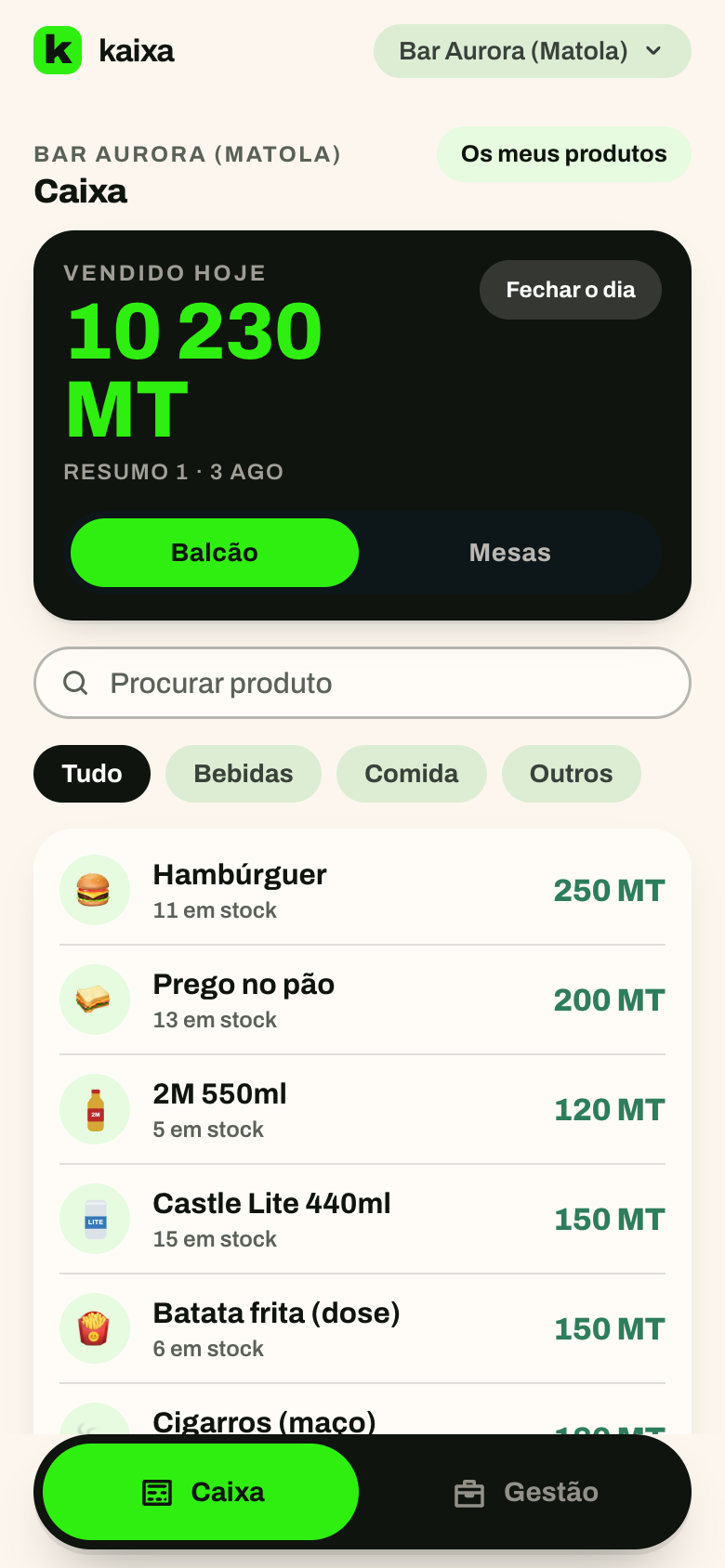
  • Caixa - the register.Tap the product, tap Cobrar. Counter mode or tables. Cash, card, M-Pesa, eMola on every sale.
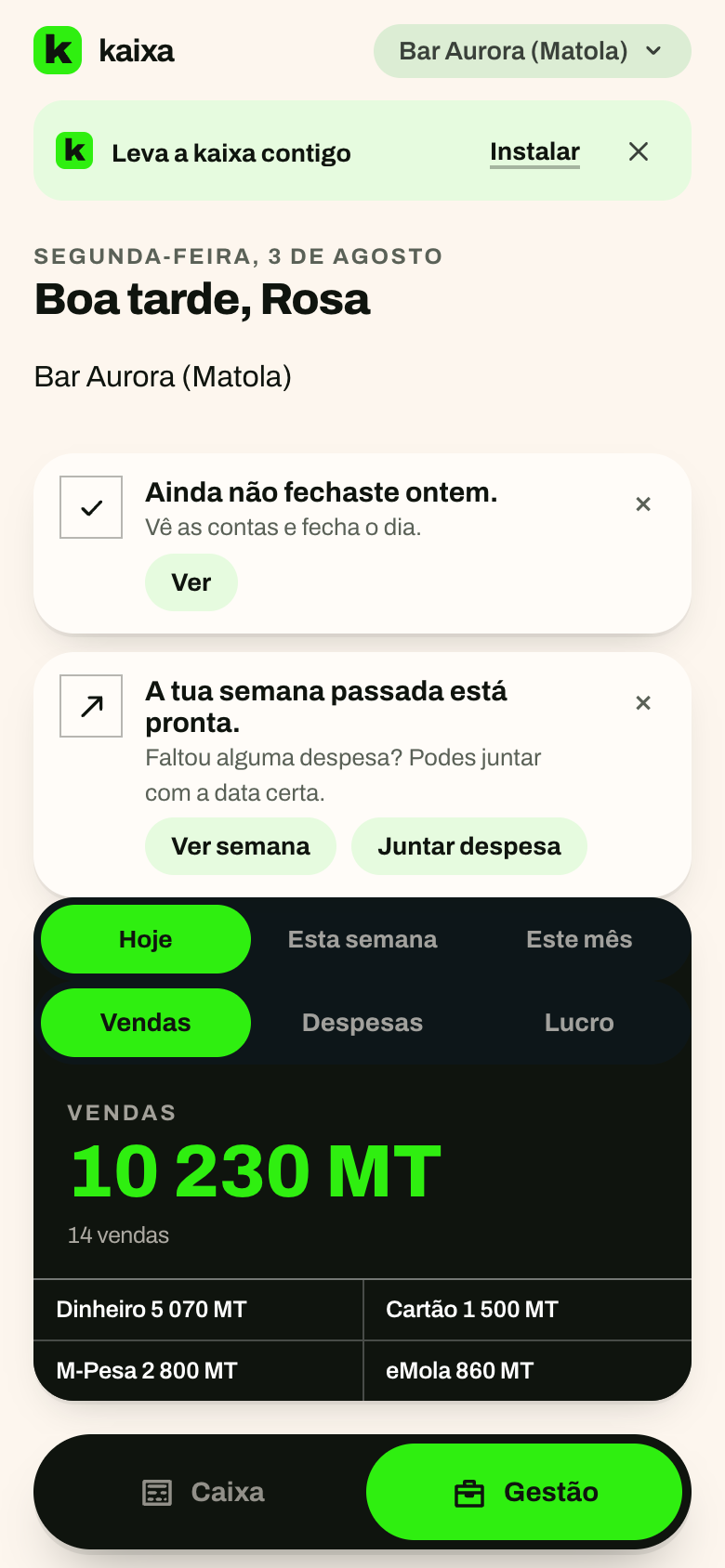
  • Gestao - everything underneath.Stock, expenses, the day's close, reports, products, staff PINs.
  • Every number ties to an append-only log.A void is a new event, never an edit. Nothing can be quietly rewritten - which is what makes it a control, not a notebook.

"This isn't an operating system. This is a simple tool to help people run the day to day of their business."

Hugo, 3 August 2026
The kaixa till screen
04 / 10
The moment it exists for

Fecho do Dia.

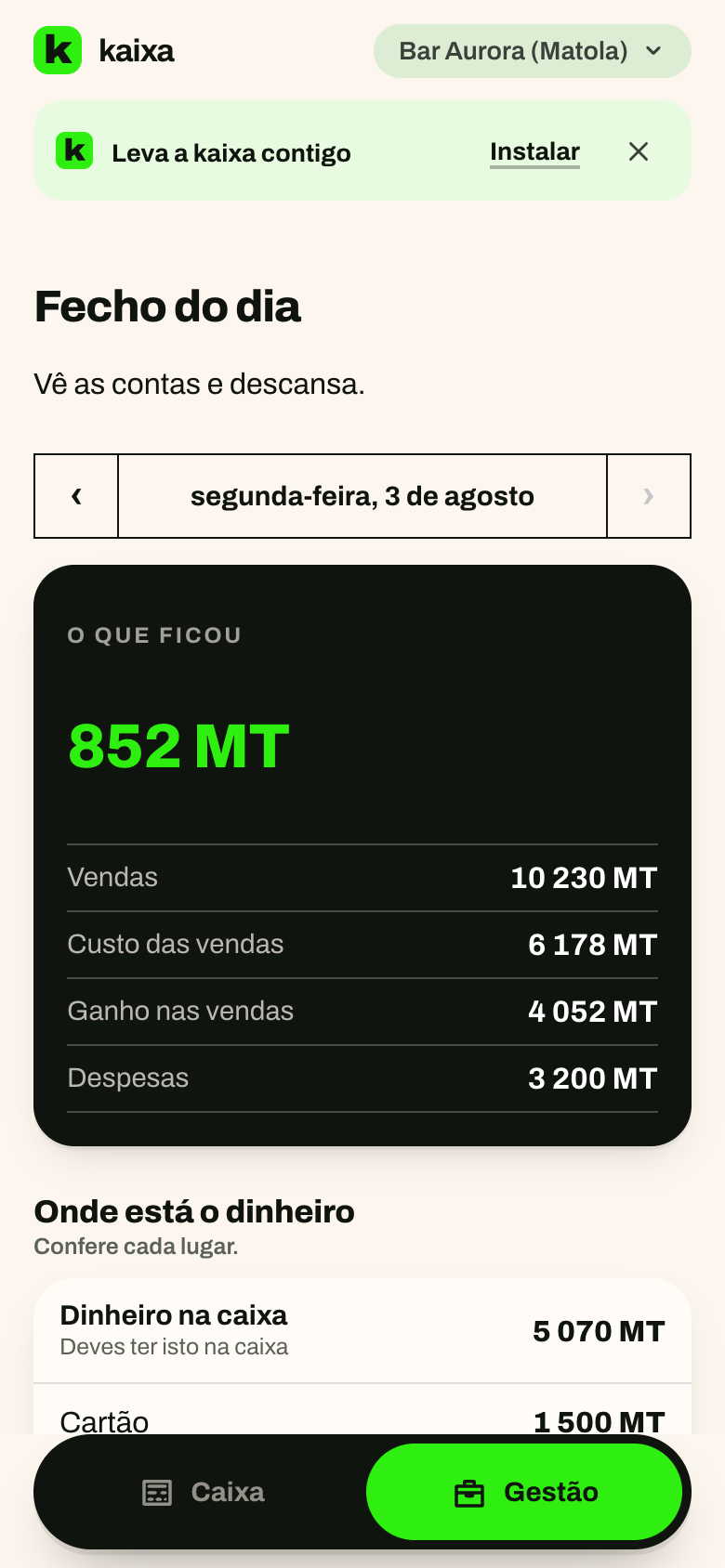
At the end of the day the owner taps once and sees what a pen-and-paper trader has never been able to see without help.

  • What you sold today.And what it cost you, so the number at the bottom is profit rather than turnover.
  • Where the money should be.Cash box against card against M-Pesa against eMola - the count that catches the difference between a bad day and a leak.
  • What should still be on the shelf.Product by product. Go and look; the gap is the answer.

If that screen makes a merchant ask when they can have it, the product works. Everything else in this deck is in service of getting somebody to it.

The day-close screen
05 / 10
Getting in

From a phone number to your own shop in six taps.

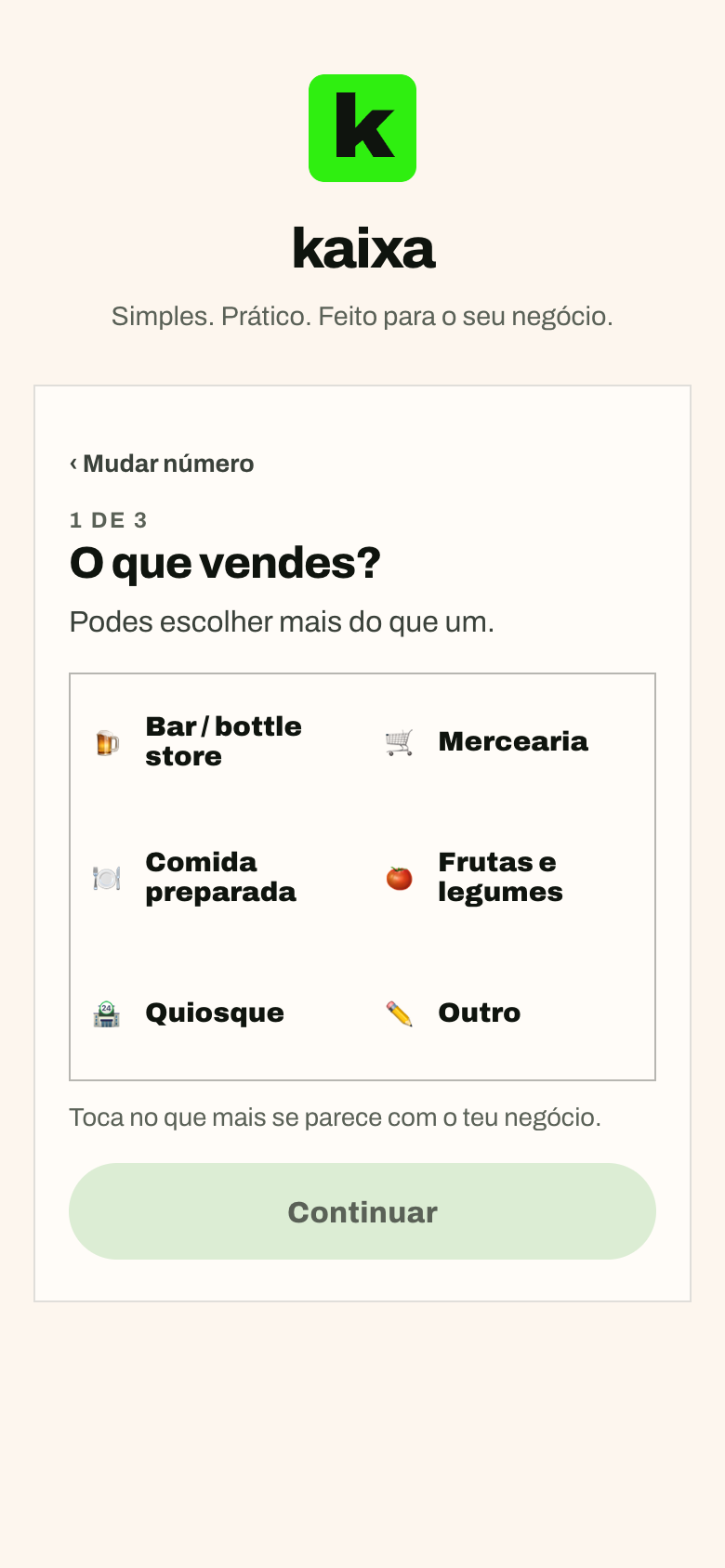
  • Five questions, and not one of them is hard.Your number, the code we text you, what you sell, what it is called, where it is. Selling price is the only number a trader carries in their head, so nothing in the flow asks for another one.
  • The shelf is already stocked when you arrive.Say “bar” and twelve products land priced and ready. Say bar and mercearia and you get both, with nothing duplicated.
  • It is measured, not asserted.6 taps, 5 questions, 3 fields typed. A build that raises any of those numbers fails the check and has to say what it bought.

Onboarding outranks every other screen in this product. A user who leaves in the first two minutes never reaches Fecho do Dia, so polish spent on experienced users is polish spent on the people who already got past the part that loses everybody else.

What do you sell? The merchant's own till, stocked
06 / 10
The price

Free for everyone. Forever.

"No one's going to feel like they're being held ransom because the switching cost is too high. But that is actually the case."

Tiago, 3 August 2026
07 / 10
What protects it

The moat is everything a merchant would have to leave behind.

08 / 10
Route to market

The customers already exist, and somebody already visits them.

  • A distribution network, not a marketing budget.More than 250,000 customers, visited by a salesforce that already carries handheld technology into their shops every week.
  • A standalone app on the Play Store.Published under the corporate entity, deliberately outside the Handling stable, so it can be sold into sectors Handling has nothing to do with.
  • Support that scales without people.AI chat and generated instructional video, then a YouTube channel. Assisted onboarding for the largest customers runs as a parallel experiment - never as the requirement.
The management hub
09 / 10
What comes next

The till first. Then the money. Then the credit.

10 / 10
Where it stands

Fourteen rounds in. Live, and honest about what is not real.

Real today

  • The till, counter and tables, with four payment methods
  • Day close, reopen, voids - all append-only
  • Stock count, expenses, reports, products, staff PINs
  • Registration and onboarding for a brand-new shop
  • Installs to the home screen and works offline
  • 84 automated tests; a design audit at 0 fail, 0 warn

Simulated, and knowingly so

  • The one-time password - the demo code is 1234
  • The Handling delivery feed
  • All data. There is no backend yet; everything lives on the phone
  • Nobody has used it in a real shop
$5
a month to host, today. Tiago's read: marginal cost per user is very small and falling - manageable even at a million.
0
dependencies, build steps and network requests. It cannot break because somebody else's library changed.
3
open owner decisions: the home domain, when the pilot starts, and whether the green brand goes into the main build.

Customer figures are the portfolio's approved claims, live-verified 20 July 2026 - re-verify before any external use. Onboarding counts are measured on every build. Quotations are from the 3 August call transcript, not its summary.